


Moving to a new office can support growth, reduce costs and create a better working environment. However, an office relocation also affects employees, customers, technology, suppliers and everyday business operations.
Unlike a residential move, it is rarely enough to pack everything, transport it and unpack at the new address. Computers must be ready, files must remain organised, access must be coordinated and employees need to know where to be and when. If one part of the plan is overlooked, the business may face avoidable delays and disruption.
The solution is to treat your office move as a structured project.
This complete guide explains how to plan office removals from the initial decision through to the final checks at your new premises. It is suitable for small and medium-sized businesses planning a relocation in Bedford, Milton Keynes or elsewhere in the UK.
What Is an Office Relocation Plan?
An office relocation plan is a working document that identifies everything your business must complete before, during and after the move.
It should define:
- the reason for relocating;
- the proposed moving date;
- the available budget;
- the people responsible for each task;
- the furniture, equipment and files being moved;
- the services required from the removal company;
- the IT shutdown and reconnection process;
- access arrangements at both properties;
- employee and customer communications;
- contingency plans for unexpected delays.
The plan does not have to be complicated, especially for a small office. A spreadsheet or shared project board may be sufficient. What matters is that every task has an owner, a deadline and a clear status.
Without this structure, important jobs are easily missed or left until moving day.
Planning an office move?
Get a Free Office Removal Quote
Tell MarioVans about your offices, preferred moving date and the support you need. Our team will help you plan a safe, organised relocation with minimal disruption to your business.
Office removals across Bedford, Milton Keynes, London and surrounding areas.
When Should You Start Planning an Office Removal?
Start planning as soon as the new premises and likely moving period are known.
A relatively small office with limited furniture and straightforward access may need approximately eight to twelve weeks of preparation. A larger or more complex relocation can require several months, particularly when it involves new internet connections, servers, multiple departments, lease works or several phases.
Your schedule should allow time to:
- appoint an internal move coordinator;
- survey both properties;
- prepare an inventory;
- request and compare removal quotations;
- organise internet and telephone services;
- decide what will be moved, stored or disposed of;
- arrange packing materials;
- notify employees, customers and suppliers;
- confirm parking, loading and building access;
- test the new workspace before the move.
The physical transportation may take only a day or a weekend. The preparation that makes that day successful takes considerably longer.
Avoid choosing a date based only on the end of your lease. Consider business deadlines, seasonal demand, staff availability, building restrictions and the time required to make the new office operational.
Appoint an Office Removal Coordinator
Every office relocation needs one person with overall responsibility for the project.
For a small company, this might be the owner, office manager or operations manager. A larger organisation may need a relocation team with representatives from operations, finance, facilities, HR and IT.
The coordinator should:
- maintain the relocation schedule;
- keep the inventory up to date;
- communicate with the removal company;
- confirm decisions with management;
- assign tasks to employees;
- coordinate landlords and building managers;
- record access requirements;
- monitor the budget;
- escalate problems before they affect the moving date.
This does not mean one person must complete every task. Their role is to make sure every task has been assigned and completed.
Nominate a backup contact as well. The move should not stop because the main coordinator is unavailable on the day.
Define the Scope of the Office Removal
Before requesting quotations, establish exactly what the relocation involves.
Ask the following questions:
- Is the entire company moving at the same time?
- Will any departments remain operational at the old address?
- Are furniture and equipment moving directly to the new office?
- Will anything require temporary storage?
- Does furniture need to be dismantled and reassembled?
- Does the business need packing and unpacking assistance?
- Are there confidential files or specialist items?
- Who will disconnect and reconnect the technology?
- Must the move happen outside normal business hours?
- Is waste or unwanted furniture being removed separately?
A clear scope helps removal companies prepare accurate quotations. It also prevents assumptions about what is or is not included.
If you change the scope later, update the schedule, quotation and responsibilities accordingly.
Create a Detailed Office Removal Inventory

equipment and boxes organised throughout
the relocation.
An inventory is one of the most useful documents in an office move. It shows what the business owns, what is moving and where each item should go.
Record items such as:
- desks and office chairs;
- cabinets and shelving;
- computers and monitors;
- printers and scanners;
- telephones and network equipment;
- meeting-room furniture;
- kitchen equipment;
- stock and promotional materials;
- archives and confidential files;
- artwork, screens and audiovisual equipment.
Give larger or important items a reference number. The same reference can appear on the inventory, the item label and the new office floor plan.
Divide the inventory into four categories:
- Move to the new office.
- Place in temporary storage.
- Reuse, sell or donate.
- Recycle or dispose of responsibly.
There is little value in paying to move items that the business no longer needs. Completing this exercise early can reduce the volume, cost and complexity of the relocation.
Set a Realistic Office Relocation Budget
The removal quotation is only one part of an office relocation budget.
Your budget may also need to cover:
- packing materials;
- packing and unpacking services;
- furniture dismantling and reassembly;
- storage;
- cleaning;
- disposal of unwanted items;
- IT specialists;
- internet installation;
- new furniture or equipment;
- access or parking charges;
- additional security;
- insurance requirements;
- reinstatement work at the previous office;
- contingency costs.
Office removal prices depend on several practical factors, including the volume being moved, the distance, access at both buildings, the number of floors, lift availability, staffing requirements and whether the move takes place outside normal working hours.
Provide removal companies with the same information when comparing quotations. A lower figure is not necessarily better if it excludes packing, materials, furniture assembly or additional labour.
Ask for a written quotation that clearly states what is included, what is excluded and which circumstances could change the final price.
Office removal costs can vary considerably depending on the volume of furniture and equipment, travel distance, building access, packing requirements, IT equipment, scheduling and temporary storage. Read our complete guide to office removal costs in the UK to understand the main pricing factors and prepare a more accurate relocation budget.
Choose the Right Office Removal Company
An office move requires more than access to a van. The removal company must understand commercial premises, shared access, business-critical equipment and the importance of working to a schedule.
Before booking, ask prospective movers about:
- their experience with office and commercial relocations;
- the information needed to prepare the quotation;
- whether they will survey the properties;
- their insurance and goods-in-transit cover;
- packing materials and packing services;
- furniture dismantling and reassembly;
- the handling of computers and office equipment;
- evening or weekend availability;
- storage options, when required;
- the number of movers and vehicles assigned;
- their procedure if the move takes longer than expected;
- responsibility for damage or delays.
The company should ask detailed questions about the buildings and the contents being moved. A quotation based only on the number of desks may overlook stairs, long carrying distances, restricted loading areas or specialist equipment.
MarioVans provides professional office removal services, including packing, transportation of office equipment and furniture assembly. Businesses relocating locally can also explore dedicated office removals in Milton Keynes.
Choosing the right removal company can make the difference between a smooth office relocation and unnecessary disruption. Before booking, check the company’s experience, insurance, quotation scope, packing services, equipment, scheduling flexibility and approach to delays or unexpected problems. Read our guide on how to choose an office removal company for 12 essential questions to ask before making your decision.
Build a Practical Office Removal Timeline
Once the moving date is confirmed, work backwards and divide the project into manageable stages.
Eight to twelve weeks before the move
- Confirm the scope and budget.
- Appoint the move coordinator.
- Prepare the initial inventory.
- Request removal quotations.
- Survey the new office.
- Order internet and telephone services.
- Review lease and building requirements.
- Decide which furniture and equipment will move.
Four to eight weeks before the move
- Book the removal company.
- Confirm the new floor plan.
- Assign desks, departments and equipment to specific areas.
- Arrange storage or disposal if required.
- Create the IT relocation plan.
- Notify employees of the main arrangements.
- Confirm access with both building managers.
Two to four weeks before the move
- Finalise the inventory.
- Begin packing non-essential files and equipment.
- Label furniture and boxes.
- Confirm parking, loading bays and lifts.
- Update customers, suppliers and service providers.
- Test internet, power and essential systems at the new premises.
- Review the contingency plan.
During the final week
- Confirm timings and contact details with everyone involved.
- Back up business data.
- Pack remaining non-essential items.
- Issue employee instructions.
- Prepare keys, access cards and alarm information.
- Check the new office is clean, safe and ready.
- Confirm the order in which departments will be moved.
On moving day
- Brief the removal team.
- Protect floors, walls and shared areas where necessary.
- Check items against the inventory as they leave.
- Keep emergency contacts available.
- Direct items to their allocated locations.
- Record damage or missing items immediately.
- Prioritise equipment needed to restart operations.
A timeline must reflect your actual organisation. A five-person office does not need the same process as a multi-floor business, but both benefit from deadlines and assigned responsibilities.
Prepare the New Office Before Moving Day
Do not wait until the removal vehicle arrives to discover that desks will not fit or the internet connection is not active.
Before the move, confirm:
- the floor plan and workstation layout;
- measurements for large furniture;
- the position of power and network points;
- internet and telephone activation;
- lighting, heating and ventilation;
- kitchen and welfare facilities;
- fire exits and safety procedures;
- security systems and access cards;
- loading and parking arrangements;
- lift dimensions and booking requirements;
- permitted working and delivery hours.
Give the removal company a copy of the floor plan. Use colours or reference numbers to show where each department, workstation and item should be placed.
This reduces repeated instructions and prevents furniture from being left in the wrong area.
At managed buildings, business parks and serviced offices, speak to the building manager in advance. Some properties require loading slots, contractor details, lift reservations or proof of insurance.
Coordinate IT, Telecoms and Business Equipment
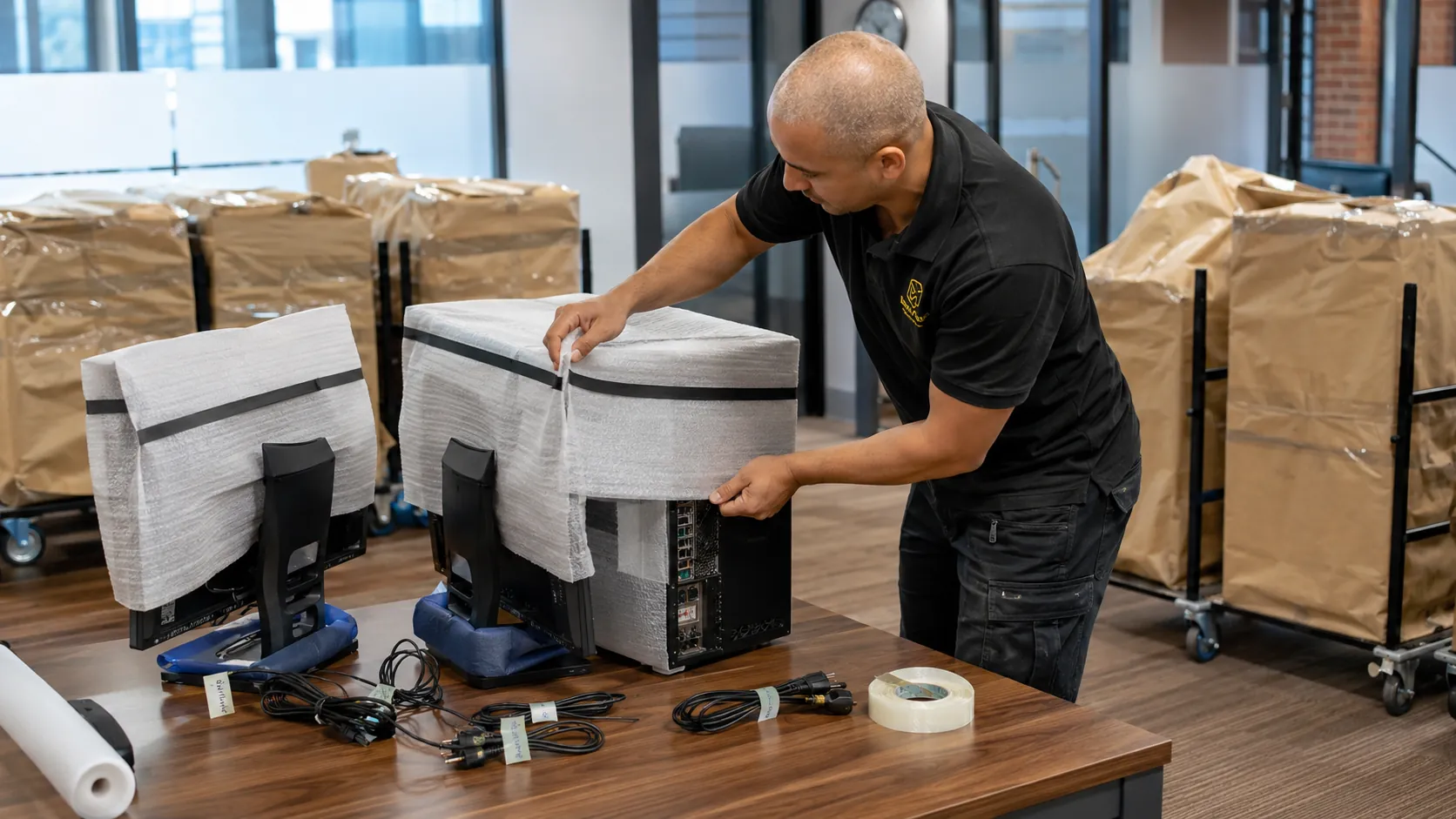
should be labelled, protected and
coordinated with the company’s
IT provider.
Technology is often the most sensitive part of an office move. A desk can be repositioned later; an inactive internet connection may prevent the company from trading.
Create a separate IT relocation plan covering:
- computers, monitors and peripherals;
- servers and network equipment;
- telephones and telephone numbers;
- printers and scanners;
- internet installation;
- data backups;
- software and access permissions;
- specialist business systems;
- equipment required immediately after the move.
Your IT provider should decide how equipment will be shut down, disconnected, backed up, reconnected and tested. The removal company can then coordinate the packing and physical transportation agreed within its service.
Do not assume the movers will configure networks or make technical changes unless this has been expressly included.
Label each device and its cables so they can be matched to the correct employee or workstation. Take photographs of complex connections before disconnection and maintain a record of serial numbers for important assets.
Arrange testing before employees return. Internet access, telephones, shared drives, printers, payment systems and other essential services should be checked in order of business priority.
For a detailed process covering backups, equipment inventories, secure packing, chain of custody and reconnection priorities, follow our Office IT Relocation Checklist: Moving Computers, Servers and Business Equipment Safely. It also explains which tasks should be handled by your IT provider and which packing and transportation responsibilities should be agreed with the removal company.
Communicate the Office Removal Plan Clearly
Employees need more than the new address and moving date.
Tell them:
- why the business is relocating;
- when the move will take place;
- whether working arrangements will change;
- what they must pack themselves;
- how boxes and personal items should be labelled;
- when existing workstations will become unavailable;
- where and when they should report after the move;
- who to contact with questions;
- what they must not pack or transport.
Customers and suppliers may also need advance notice, especially if the relocation affects deliveries, appointments or telephone availability.
Review everywhere your address appears, including:
- the company website;
- Google Business Profile;
- invoices and quotations;
- email signatures;
- stationery and business cards;
- banks and insurers;
- suppliers and couriers;
- professional bodies;
- online directories;
- contracts and licences.
If the company’s registered office changes, it must also update Companies House. The address does not officially change until it is registered. Check the current requirements on the official Companies House guidance.
Create a central notification list so that each organisation can be marked as updated.
Decide What to Move, Store or Remove

and flexible office removal services for businesses
in Bedford, Milton Keynes and surrounding areas.
Not everything needs to travel directly from one office to the other.
Temporary storage may be helpful when:
- the leases do not overlap;
- the new premises are still being prepared;
- departments are moving in stages;
- the business is reducing its floor space;
- archived documents are not needed immediately;
- surplus furniture may be reused later.
Before placing anything in storage, record its condition, assign a reference and identify the expected retrieval date. Confirm who can access the stored items and whether additional insurance is required.
Unwanted furniture, electronics and business waste need separate planning. Businesses have responsibilities when transferring waste, so confirm how items will be reused, recycled or disposed of and retain any necessary documentation.
Reduce Downtime With the Right Office Removal Schedule
The best time to relocate depends on how your business operates.
A weekday move may offer easier access to landlords, suppliers and IT support. However, it can interrupt employees and customer activity.
An evening or weekend move may protect normal working hours, but it requires confirmation that the building, removal team, internal staff and technical providers are all available.
Other options include:
- moving one department at a time;
- relocating non-essential items first;
- using temporary remote working;
- maintaining a small operational team at the old office;
- completing the physical move before the IT switchover;
- prioritising essential workstations at the new location.
The goal is not always to eliminate every minute of downtime. It is to identify which functions must remain available and build the sequence around them.
MarioVans offers flexible scheduling for office relocations, including evening and weekend options where arranged in advance.
Prepare a Office Removal Day Control Pack
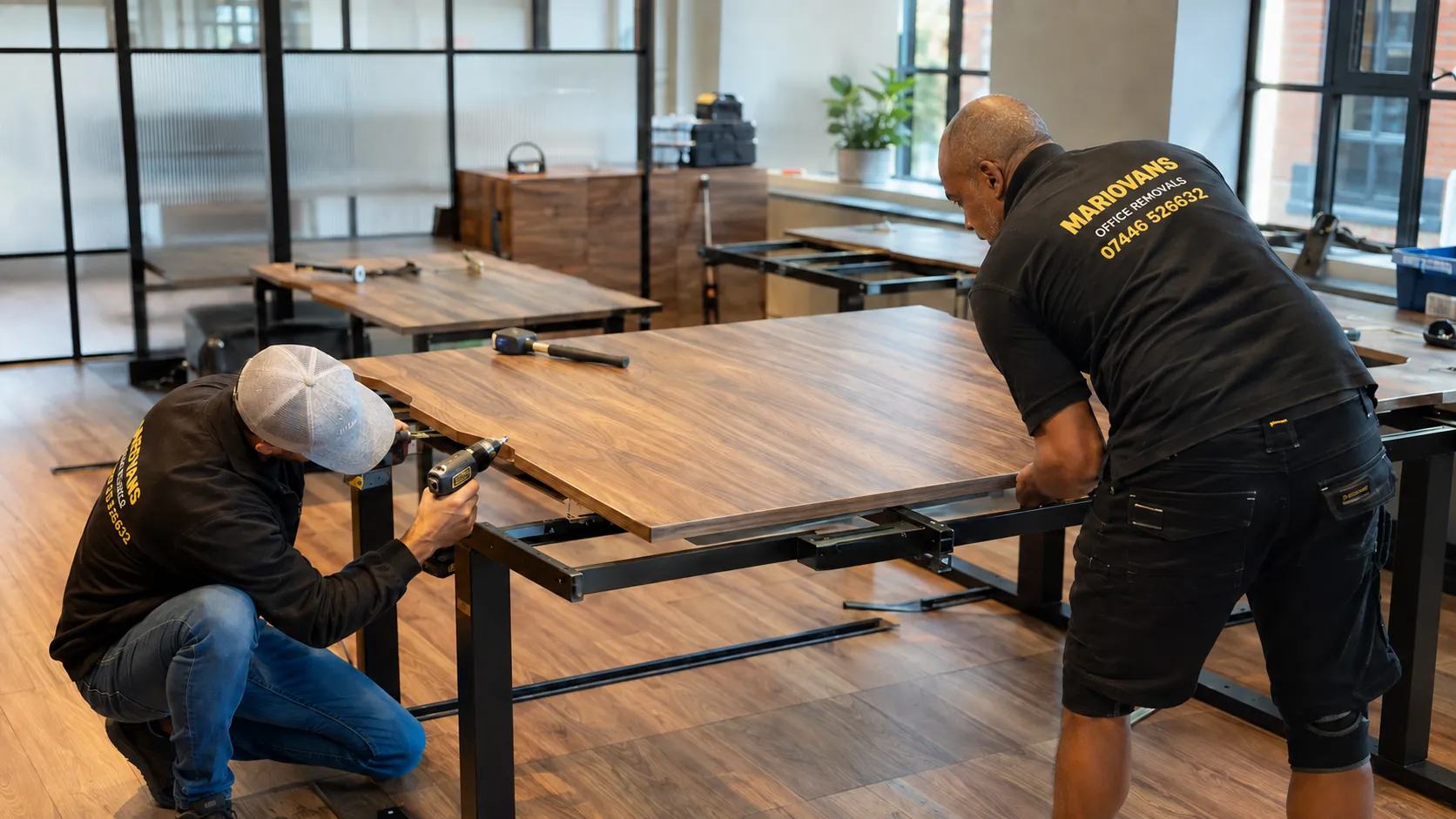
in advance helps make moving day
faster and more organised.
The move coordinator should keep essential information accessible rather than packing it in a box.
The control pack should include:
- the current inventory;
- floor plans;
- the removal quotation and agreed scope;
- contact details for the removal company;
- landlord and building-management contacts;
- IT support contacts;
- access instructions;
- vehicle and parking information;
- keys and access cards;
- emergency procedures;
- a list of priority items;
- a record for reporting damage or missing items.
Keep chargers, a laptop, important documents and basic supplies available. You may also need water, cleaning materials, labels, markers and a simple toolkit.
At the beginning of the move, provide a short briefing covering the schedule, access restrictions, fragile items and placement system. One authorised person should answer questions and approve changes.
Too many people giving instructions can cause confusion.
Complete the Final Office Removal Checks
Before the removal team leaves the previous property, check:
- desks, cabinets and storage areas;
- meeting rooms and kitchens;
- cupboards and server rooms;
- walls and mounted equipment;
- external storage;
- keys and access cards;
- items scheduled for disposal or collection.
At the new office, confirm that:
- items have reached the correct departments;
- furniture is stable and positioned safely;
- essential equipment is present;
- entrances and fire exits are unobstructed;
- visible damage has been recorded;
- packaging and waste are managed;
- priority systems can be tested.
The relocation is not complete simply because everything has been unloaded.
After employees return, collect feedback and maintain a short list of outstanding tasks. These might include furniture adjustments, missing labels, additional equipment, signage or supplier updates.
Planning Office Removals in Bedford and Milton Keynes
The fundamental planning process is the same in every town, but local building access can change how the move is delivered.
Businesses relocating in Bedford or Milton Keynes may operate from serviced offices, town-centre premises, industrial estates or business parks. Each property can have different arrangements for parking, loading, lifts, reception access and out-of-hours work.
Do not rely on general assumptions about an area. Ask the building manager at each address:
- where removal vehicles may park;
- whether a loading bay must be reserved;
- if lifts have to be booked;
- which entrances contractors should use;
- whether access is permitted during evenings or weekends;
- if proof of insurance or contractor information is required;
- how walls, floors and communal areas must be protected.
For moves within Milton Keynes, MarioVans provides a dedicated Office Removals Milton Keynes service.
Businesses looking for a more detailed task list can also consult our Office Removals Milton Keynes Checklist for Small Businesses.
How MarioVans Can Support Your Office Relocation
A well-planned office move protects your equipment, your employees and your ability to continue operating.
MarioVans supports businesses with professional office removals tailored to the size, access requirements and schedule of each relocation. Depending on the agreed service, assistance can include:
- packing and unpacking;
- protective materials;
- careful transportation of office furniture and equipment;
- dismantling and reassembly of furniture;
- handling of files and business contents;
- coordination with your internal team;
- flexible scheduling, including out-of-hours moves;
- placement of items at the new premises.
Contact MarioVans early enough to discuss both properties, your preferred date and the level of assistance required. A detailed conversation or survey allows the team to prepare an appropriate plan and quotation.
Request a free office removal quote or call 07446 526632 to discuss your business relocation.
Frequently Asked Questions About Office Removals
A small, straightforward office move should normally be planned at least eight to twelve weeks in advance. Larger relocations may require several months. Internet installation, lease requirements, building access, furniture decisions and IT preparation often determine the timeline more than the physical transportation itself.
The physical move of a small office may be completed within a day, while a larger or more complex relocation may require several days or separate phases. The complete project—from planning to restarting operations—usually takes considerably longer and depends on the number of employees, amount of equipment, access and technical requirements.
The cost depends on the volume of furniture and equipment, travel distance, access, number of movers, packing requirements, furniture assembly, timing and any storage needed. The most reliable way to establish the cost is to provide a detailed inventory and arrange a survey or consultation.
Plan essential systems first, arrange internet and telephone services in advance, back up data and move departments in a logical order. Evening, weekend or phased relocations can help, but IT specialists, building access and key employees must all be coordinated.
Neither option is automatically better. A weekday move can provide easier access to suppliers and building managers, while a weekend move may reduce disruption to normal operations. Compare access, cost, staff availability and the time needed to test systems before deciding.
Responsibilities should be agreed before the move. An internal or external IT specialist will usually manage data backups, technical shutdown, disconnection, configuration and testing. The removal company can pack and transport equipment according to the agreed service. Never assume technical work is included unless it appears in the quotation.
Employees can normally pack personal belongings, desk contents and non-sensitive materials following the company’s instructions. Shared files, IT equipment, confidential documents and furniture should be managed through the central relocation plan.
Many office removal companies can provide boxes, wrapping and protective materials, but the service and cost vary. Confirm what is included in your quotation, when materials will be delivered and whether the movers will also provide packing and unpacking assistance.
Be ready to provide both addresses, the preferred date, an inventory, photographs or survey access, floor and lift details, parking information, working-hour restrictions and the services required. You should also identify fragile equipment, furniture requiring dismantling, confidential files and any storage needs.
Start Planning Your Office Move
The earlier you create your relocation plan, the more options you have for solving problems before they interrupt the business.
Begin with three practical steps:
- appoint the person responsible for the project;
- prepare an inventory of everything being moved;
- arrange a detailed conversation with an experienced office removal company.
MarioVans provides professional office removal services across Bedford, Milton Keynes, London and surrounding areas. We can help you plan the physical relocation, protect your office contents and organise a schedule designed around your business.
Get your free office removal quote or call 07446 526632 today.
Planning an office move?
Get a Free Office Removal Quote
Tell MarioVans about your offices, preferred moving date and the support you need. Our team will help you plan a safe, organised relocation with minimal disruption to your business.
Office removals across Bedford, Milton Keynes, London and surrounding areas.