


An office move can cost anywhere from a few hundred pounds for a small, local relocation to several thousand pounds for a larger, more complex project. The reason the range is so wide is simple: your final price is never based on desk count alone.
Volume, access, distance, packing, IT equipment, working hours and storage all shift the number up or down. Two businesses moving the exact same number of employees can receive two very different quotations, and if you go in without understanding why, it is easy to compare the wrong things.
This guide breaks down exactly how UK office removal costs are calculated, which services are usually charged separately, and how to compare quotes properly instead of chasing a misleading “average.”
Important: the figures and scenarios in this article are illustrative market ranges, not MarioVans prices or fixed quotations. Every business relocation is assessed individually.
What Is the Average Cost of an Office Removal in the UK?
Here is the honest answer: there is no single reliable “average cost” of an office move, and any site that gives you one flat number without asking a single question about your building is guessing.
Published UK market guides suggest a small, local office removal typically falls somewhere between a few hundred pounds and a few thousand pounds. A medium-sized relocation can run into several thousand pounds, and a large, multi-floor or technically complex move may require a substantially higher budget.
We can all agree that these figures are only broad reference points. Moving ten desks between two accessible ground-floor offices in the same town is a completely different job to moving the same ten desks down from a third floor with no lift, dismantling them, packing every computer, and delivering it all on a weekend.
When you set your budget, separate the cost of the physical removal from the wider cost of relocating the business. Your total project budget may include:
- Professional removal services
- Packing materials and crate hire
- Packing and unpacking labour
- Furniture dismantling and reassembly
- IT disconnection, reconnection and testing
- Temporary storage
- Disposal or recycling of unwanted items
- Building or loading-bay charges
- Cleaning and repairs
- New furniture, signage or equipment
- Lease, survey and legal costs
- Lost productivity or temporary working arrangements
A removal company’s quotation will usually cover only some of these items. Always check the scope before you compare it against your total relocation budget, not just against another mover’s headline figure.
Planning an office move?
Get a Free Office Removal Quote
Tell MarioVans about your offices, preferred moving date and the support you need. Our team will help you plan a safe, organised relocation with minimal disruption to your business.
Office removals across Bedford, Milton Keynes, London and surrounding areas.
How Do Removal Companies Calculate Office Removal Costs?
Professional removal companies calculate price by estimating the labour, vehicle capacity, travel time and total time required to complete the agreed scope of work. It is not a postcode lottery, and it should never feel like one.
To prepare an accurate quotation, a mover will usually ask for:
- The collection and delivery addresses
- The proposed moving date
- An inventory of furniture, equipment and boxes
- Photographs or videos of the contents
- Access information for both premises
- Floor and lift details
- Parking or loading restrictions
- The services required
- Details of fragile, heavy or specialist items
- Any storage or clearance requirements
For larger or more complicated moves, an on-site or video survey is worth arranging. You should agree that catching a practical issue before moving day, rather than on it, is always the cheaper outcome.
The quotation will then normally be presented in one of two ways: a fixed price for the agreed scope, or a rate calculated by labour and time. Ask which method is being used, and which specific circumstances could change the final amount.
The Main Factors Affecting Office Removal Costs
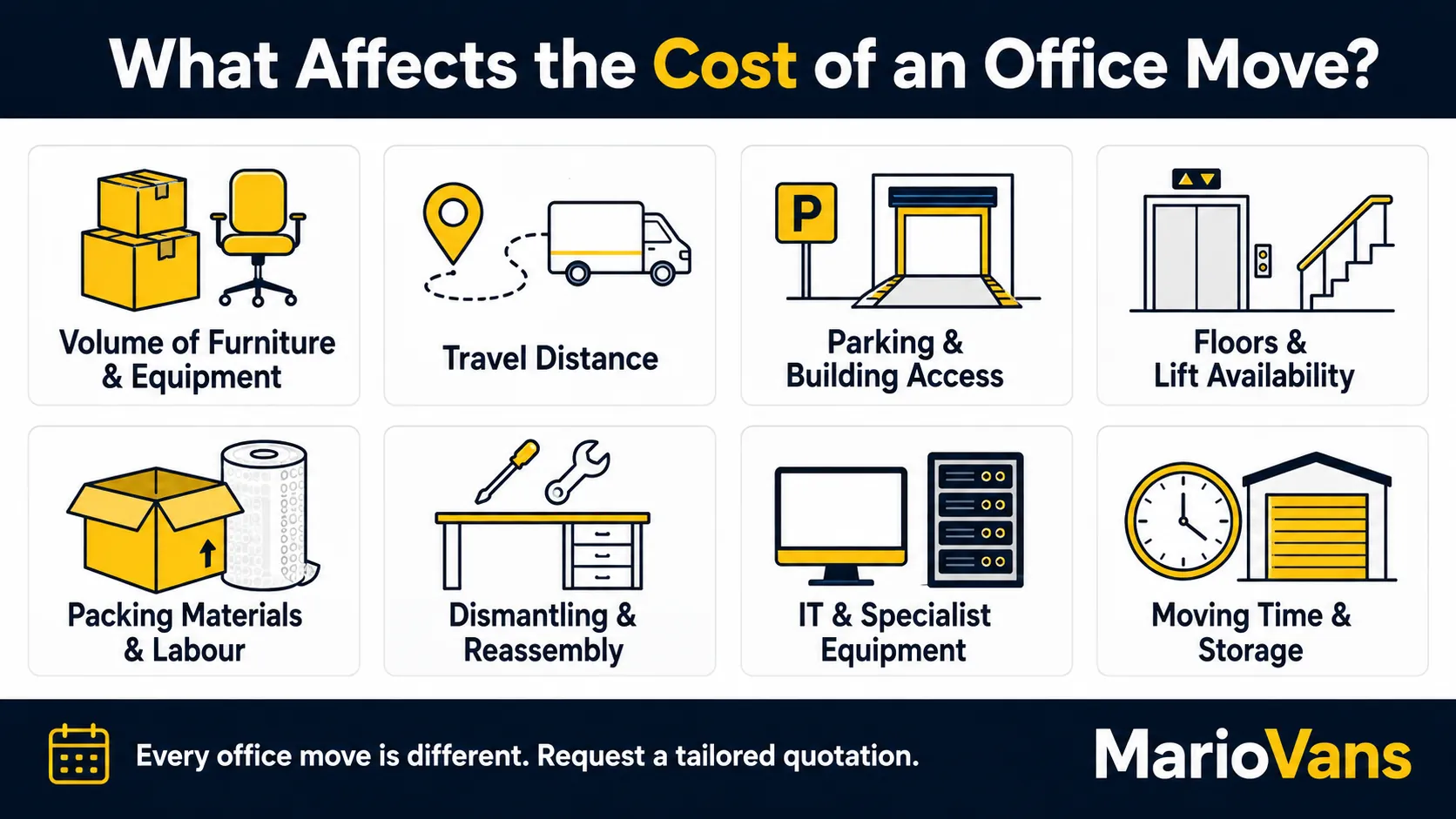
1. Volume of Furniture and Equipment
The amount being moved is one of the biggest pricing factors, full stop. More desks, chairs, cabinets, boxes and equipment mean more vehicle space and more loading and unloading time, which can mean a bigger team, a bigger vehicle, or more than one journey.
Employee headcount can give you a rough starting point, but it will not get you an accurate price on its own. A ten-person office with laptops and lightweight desks is a very different job to a ten-person office with heavy filing systems, stock and meeting-room furniture. Build an itemised inventory rather than estimating by headcount alone.
2. Distance Between the Offices
A longer journey means more driving time, more fuel and less vehicle availability for other jobs that day. For a local move within Bedford or Milton Keynes, distance is usually a small part of the total cost. For a move to another region, travel can become a major factor, especially if vehicles and crew cannot return the same day.
Distance also has to be weighed against the number of journeys. A short route repeated three times can take longer, and cost more, than a single well-planned journey over a greater distance.
Businesses relocating in the area can see MarioVans’ dedicated Office Removals Milton Keynes service for local specifics.
3. Access, Parking and Carrying Distance
Easy access can shave real time, and therefore real cost, off moving the exact same volume of contents. Costs tend to rise when:
- Parking is far from the entrance
- A loading bay must be booked in advance
- Vehicles cannot wait outside the building
- There are narrow corridors or staircases
- The office is on an upper floor
- No suitable lift is available
- The lift is small or shared with other tenants
- Building management restricts contractor access
- Long carrying distances are involved
- Floors, walls or communal areas need extra protection
Always provide access details for both addresses. Great access at the old office will not cancel out a difficult new building, so do not let one strong detail hide a weak one.
4. Floors and Lift Availability
Moving furniture down from an upper floor almost always takes longer than clearing a ground-floor office. A suitable goods lift speeds things up considerably, but it usually needs to be booked in advance. Passenger lifts often have weight, size or usage restrictions and may not take large furniture at all.
Where there is no lift, you should expect additional movers on the job to handle items safely on stairs, and some furniture may need to be dismantled before it can leave the building.
5. Packing and Unpacking
You can pack internally, or ask the removal company to provide a professional packing service, and both are valid choices depending on your team’s time and risk appetite.
Professional packing adds labour and materials to the quotation, but it reduces disruption for employees and gives more consistent protection for equipment. Price depends on what needs packing, the materials required, and whether unpacking is included. Typical requirements include:
- Reusable moving crates
- Cardboard boxes
- Computer or monitor protection
- Bubble wrap or paper
- Protective blankets
- Labels and security seals
- Specialist packaging for fragile equipment
- Confidential-file handling
Ask whether materials are purchased, hired or collected after the move, and whether the crate-hire period needs extending if unpacking is delayed.
6. Furniture Dismantling and Reassembly
Large desks, shelving systems, meeting tables and storage units often will not fit through doors or into lifts fully assembled. Dismantling and rebuilding takes extra time and the right tools, and costs climb further when furniture has a complicated modular design, missing instructions, damaged fittings, or parts that need careful matching.
Your quotation should specify exactly which furniture will be dismantled, who reassembles it, and where it will be positioned at the new office. A clear floor plan up front prevents expensive re-arranging after the fact.
Cost Drivers at a Glance
| Factor | Effect on Price | Why |
|---|---|---|
| Volume of items | High | Drives vehicle size, crew size and loading time |
| Access (stairs, lifts, parking) | High | Directly affects loading and carrying time |
| Distance | Medium | Adds fuel, driving time and vehicle availability |
| Packing service | Medium | Adds labour and materials, but reduces disruption |
| Dismantling/reassembly | Medium | Extra time, tools and skilled labour |
| Weekend or out-of-hours move | Low to Medium | May affect labour scheduling, but can cut downtime costs |
| Storage | Variable | Recurring cost based on volume and duration |
Does Moving Computers and IT Equipment Cost Extra?
The physical packing and transport of computers, monitors, printers and other office equipment can be included when it is agreed with the removal company, but the technical side of the job is normally a separate responsibility entirely.
Your internal IT team or a specialist provider will typically need to manage:
- Data backups
- Server shutdown
- Equipment disconnection
- Network configuration
- Internet and telephone services
- Reconnection and testing
- Cybersecurity and access permissions
- Disposal of obsolete devices
Do not assume a removal quotation includes technical IT services just because computers are being transported, because that assumption is where the most expensive surprises come from.
Label every device, monitor and cable by employee or workstation, and identify servers, specialist equipment and anything that needs to be operational first. A detailed technical plan may add to the wider relocation budget, but it is far cheaper than a lost day of productivity after the move.
Are Weekend Office Moves More Expensive?
Evening, weekend and bank-holiday relocations can involve different labour costs or scheduling arrangements. But moving outside normal business hours can also cut disruption dramatically and let staff get back to work sooner, so the direct price is only half the equation.
The real comparison is not simply weekday price versus weekend price. You should weigh:
- The removal quotation itself
- Employee downtime
- Availability of building management
- Lift and loading-bay access
- IT support availability
- Security or reception charges
- Time available for testing systems
- Whether employees can work remotely in the meantime
A weekday move may look cheaper on paper but interrupt a full working day. A weekend move may cost more upfront but protect normal operations, and for most businesses, that trade-off is the one that actually matters.
When Is Temporary Storage Needed?
Storage adds handling, transport and recurring rental costs, since items must be loaded, stored, and delivered again later. It becomes necessary when:
- The two leases do not overlap
- The new office is not ready
- The relocation is being completed in phases
- The business is downsizing
- Surplus furniture may be reused later
- Archived documents are not immediately required
- Refurbishment work is still in progress
Storage costs usually depend on volume, duration, access requirements and level of protection needed. Ask whether collection, redelivery and insurance are included or charged separately, and never store unidentified items. Build an inventory, label everything, and agree who is authorised to request retrieval.
Additional Costs Businesses Sometimes Overlook
A low headline figure can quickly become an expensive one if key requirements were never discussed up front. Watch out for:
- Extra labour when the move overruns
- Additional journeys caused by an incomplete inventory
- Parking charges or parking suspensions
- Delayed access to either building
- Extended crate hire
- Storage collection and redelivery
- Specialist handling for heavy equipment
- Removal of unwanted furniture
- Waste-transfer or recycling services
- Cleaning the previous office
- Protection for floors, lifts and communal areas
- Last-minute changes to date or scope
- Waiting time for keys, lifts or building access
Insurance also needs a clear conversation. Ask exactly what cover applies to goods in transit, which exclusions exist, and whether valuable or specialist items must be declared separately.
Three Illustrative Office Removal Scenarios
These examples show how requirements change the price. You’ll agree, once you see them side by side, that office size alone was never going to give you an accurate figure.
Scenario 1: Small Local Office
A team moves between two accessible ground-floor offices in the same town. Employees pack their own desk contents, and the removal team transports desks, chairs, boxes and computers. This typically requires fewer labour hours than a move involving stairs, packing and furniture assembly.
Scenario 2: Upper-Floor Office With Full Packing
A larger team moves from a second-floor office. The goods lift must be booked, professional packing is required, and modular desks must be dismantled and rebuilt. The travel distance may be short, but labour, materials, access and assembly make this a more complex, and more expensive, relocation.
Scenario 3: Phased Weekend Relocation
A business needs to stay operational and moves departments in stages over a weekend. IT specialists coordinate the equipment, temporary storage is required, and the new building applies strict access times. The direct removal cost is higher, but the schedule protects business continuity, which for most companies is worth every penny.
How to Get an Accurate Office Removal Quote
Before requesting quotes, prepare the same information for every company you approach, so you are comparing like for like:
- Create a detailed inventory
- Provide both addresses and floor details
- Explain parking, lift and loading arrangements
- Identify dismantling and assembly requirements
- Specify what your employees will pack themselves
- List computers, printers and specialist equipment
- Confirm the preferred date and working hours
- Explain any storage or clearance requirements
- Provide photographs or arrange a survey
- Request a written list of inclusions and exclusions
When comparing quotations, check that each company has priced the same scope. The lowest number on the page often excludes packing materials, furniture assembly, additional labour, or redelivery from storage, and that is exactly where a “cheap” quote stops being cheap.
Our guide to planning an office removal can help you prepare the inventory, timeline and access information before you request a price.
How Can You Reduce Office Removal Costs?
Cutting cost should never mean cutting protection or under-staffing the job. The real savings almost always come from better preparation, not a cheaper crew. Before the move:
- Remove items that are no longer required
- Avoid paying to transport broken or obsolete furniture
- Prepare an accurate inventory
- Confirm building access early
- Reserve lifts and loading areas
- Label boxes and furniture clearly
- Decide the new layout before delivery day
- Coordinate the removal and IT schedules
- Avoid unnecessary last-minute changes
- Compare quotations based on identical requirements
Ask your mover whether changing the date, packing internally, or completing the relocation in phases would make a meaningful difference. The best option depends on your operation, not on whichever rate is advertised the loudest.
Request an Office Removal Quote From MarioVans
MarioVans provides professional office removal services for businesses across Bedford, Milton Keynes, London and the surrounding areas.
Depending on your requirements, the team can assist with packing, protective materials, transportation of office contents, furniture dismantling and reassembly, and flexible scheduling. Because every business, building and inventory is different, MarioVans does not rely on a generic online price to set the final cost. Providing detailed information, or arranging a survey, lets the team calculate the labour, vehicle capacity and services your relocation actually needs.
Planning an office move?
Get a Free Office Removal Quote
Tell MarioVans about your offices, preferred moving date and the support you need. Our team will help you plan a safe, organised relocation with minimal disruption to your business.
Office removals across Bedford, Milton Keynes, London and surrounding areas.
Frequently Asked Questions
A small local office removal typically costs from a few hundred pounds into the low thousands, while medium and large moves can run into several thousand pounds. The exact figure depends on volume, access, distance, labour and any extra services such as packing or storage. This is a broad market indication, not a MarioVans price. A detailed inventory and survey give a far more reliable figure.
This varies by company, so always ask. A quote typically covers labour, the vehicle and transport of your inventory. Packing materials, professional packing, furniture dismantling and reassembly, storage, and waste disposal are often listed as separate, optional services rather than being included automatically.
Not automatically. Packing labour, boxes, crates and protective materials should be listed clearly in the quotation. Confirm whether unpacking and the collection of hired crates are also included, or charged separately.
A removal company can pack and transport computers, monitors and printers when this is agreed as part of the service. Technical work such as disconnection, network configuration and testing should normally be coordinated separately with your IT provider.
Not necessarily. Weekday labour may cost less in some circumstances, but the move itself could interrupt employees and customers for a full working day. Compare the direct removal price against the wider business cost of downtime before deciding.
For a small local move, a few weeks’ notice is often enough. For larger, multi-floor or phased relocations, booking several months ahead gives more flexibility on dates, allows time for a proper survey, and makes it easier to secure lifts, loading bays and any storage you need.
Storage is worth considering if your old and new leases do not overlap, if the new office is not ready, if the move is happening in phases, or if you are downsizing and keeping surplus furniture. Ask whether collection, redelivery and insurance are included in the storage price.
The cost can change if the inventory, access, date or requested services change, or if conditions come to light that were not disclosed at quote stage, such as restricted lift access. Always ask whether the price is fixed for the agreed scope, and which specific circumstances would allow additional charges.
Prepare both addresses, your moving date, an inventory, floor and lift details, parking information, photographs, and a list of required services. Include any packing, dismantling, IT equipment, specialist items, storage or clearance requirements so the quote reflects the job accurately from the start.