


Quick answer: decide where every piece of unwanted office furniture is going before moving day. Keep or refurbish what still works. Sell or donate surplus that someone has actually agreed to take. Send the rest through a registered waste carrier to an authorised site.
Give every item a destination, a deadline and a named person. Move it first and decide later, and you’ll usually pay to handle it twice.
It’s the week before the move. The boxes are labelled. Then someone points at the corner: six desks nobody wants, chairs with wobbly bases and a meeting table that won’t fit through the new door.
Sound familiar? Those decisions are easier while you still have time to arrange collections. Start with the furniture now; use our complete business relocation guide for the wider timeline.
- Do the inventory first. Book collections second.
- Check who owns each item before you sell, donate or bin it.
- There are five routes: keep, sell, donate, recycle or dispose.
- Donations and free collections are never guaranteed, so always have a plan B.
- Business waste comes with legal duties that stay with you after it’s collected.
- Upholstered chairs may need specialist handling.
Why Decide Before Moving Day?
Unwanted furniture takes labour, van space and room in your new office. Move it, then book another collection, and you pay for extra handling.
Removing surplus early can reduce the volume you relocate. Extra collections and treatment charges still need budgeting: our guide to office removal costs explains how the moving budget fits together.
Start With a Walk-Round and an Inventory
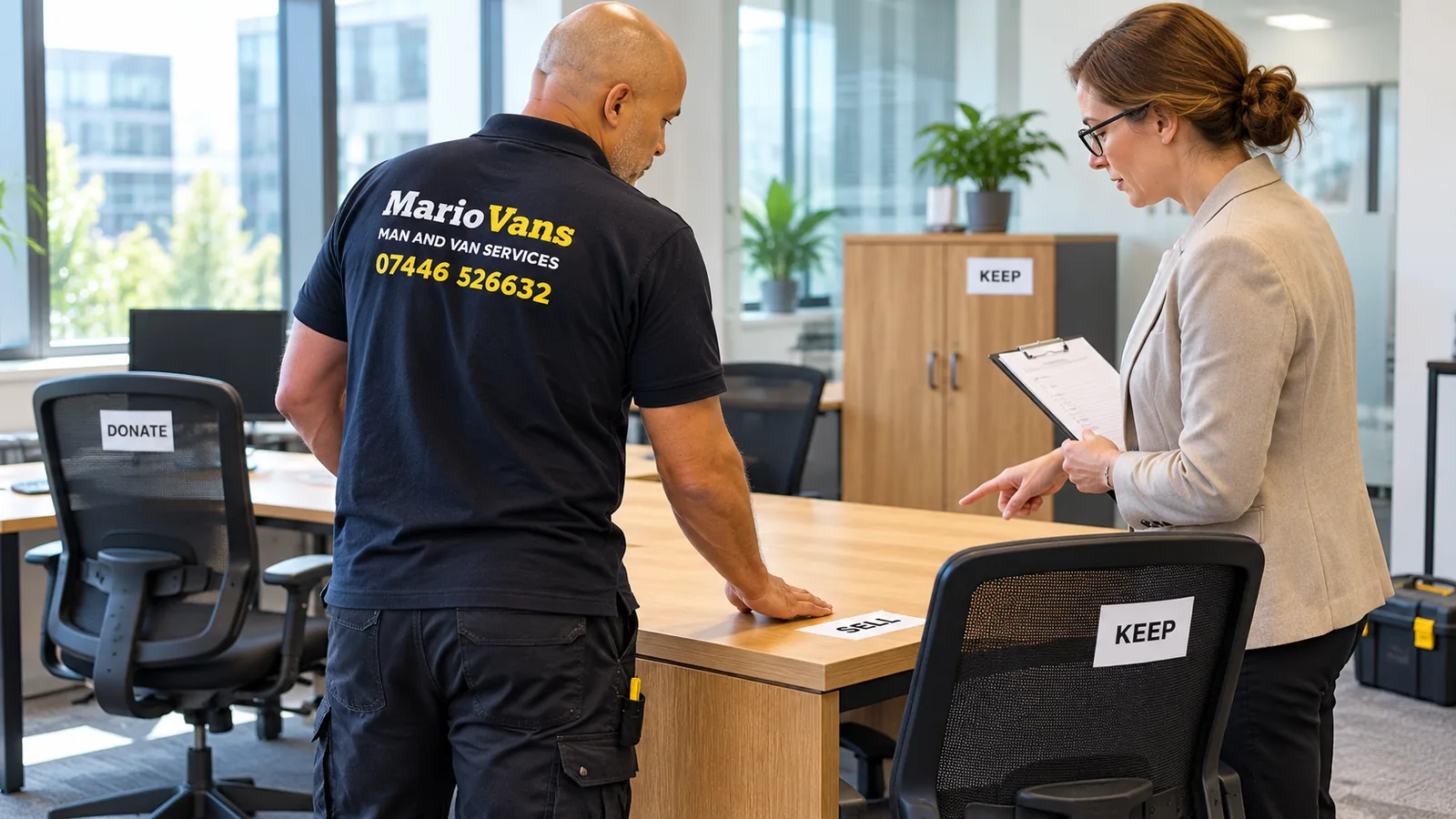
Bring the person who can approve furniture decisions, a phone and a tape measure. First check ownership: leased equipment, landlord-owned desks and fitted units may not be yours to sell or remove.
For each item, record:
- a reference, quantity and location;
- dimensions, condition and photographs;
- its proposed destination and collection deadline;
- the person responsible for the decision.
Photograph damage as well as the whole piece. Note dismantling needs, missing fittings, keys and instructions. Measure retained furniture against the new layout and access route.
Use clear labels such as KEEP, SELL and DONATE, matched to the inventory reference. Keep fittings with the relevant item and give collectors the latest approved list. Empty cabinets and check drawers for documents before releasing them.
Give undecided items a review date. “We’ll sort that later” gets expensive when the crew is waiting beside a full loading bay.
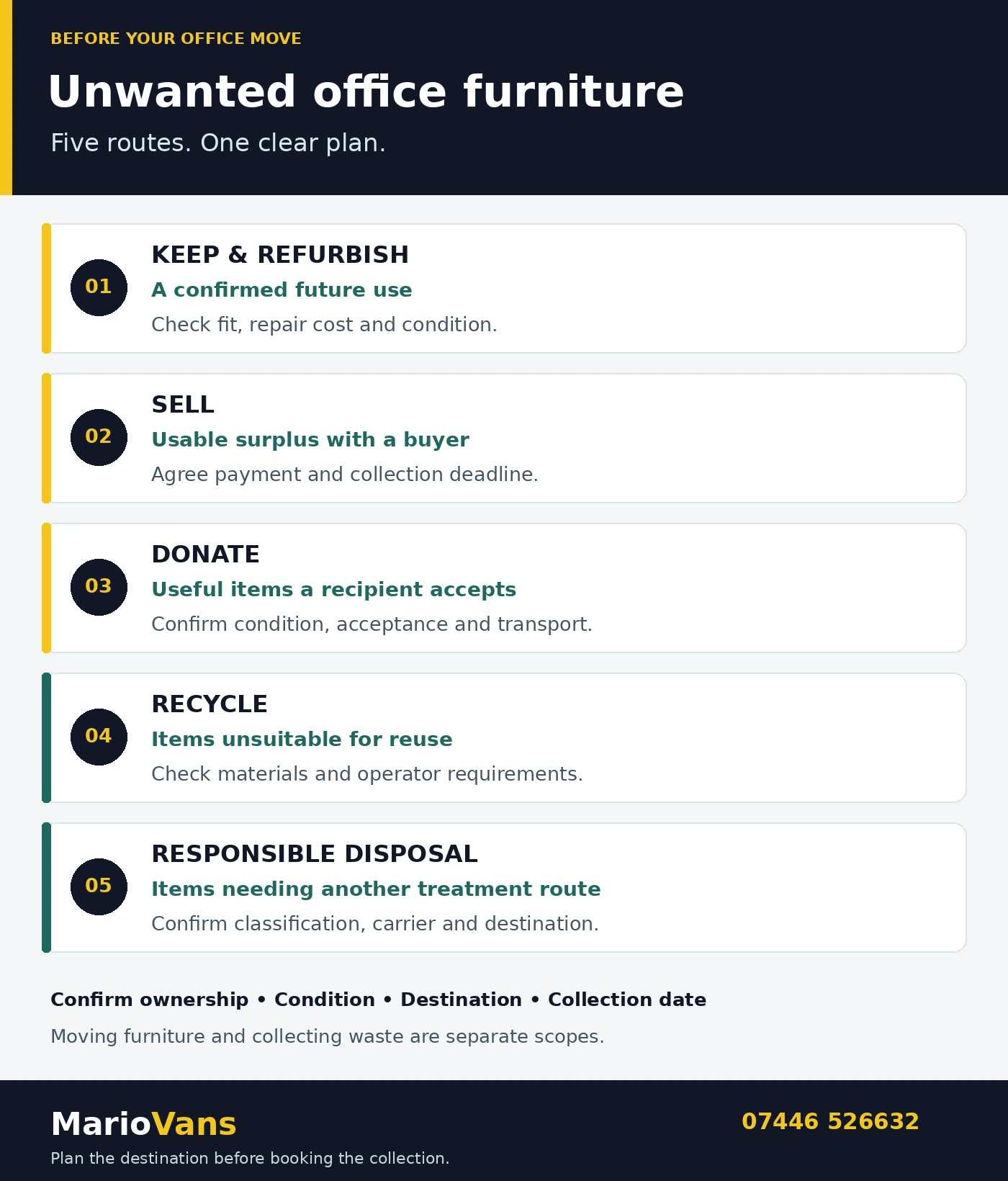
Keep, Sell, Donate, Recycle or Dispose: Which Route Fits?
| Route | Best suited to | Confirm first |
|---|---|---|
| Reuse or refurbish | Sound furniture with a future role | Fit, repair cost and user |
| Sell | Marketable, usable surplus | Buyer, payment and collection |
| Donate | Items a recipient has accepted | Condition requirements and transport |
| Recycle | Items unsuitable for reuse with recoverable materials | Acceptance, preparation and paperwork |
| Responsible disposal | Items needing another authorised treatment route | Classification, carrier and destination |
Your office may need several routes. Keep the groups separate and make the collection list clear enough for someone who has never visited the building.
Reuse: Give Good Furniture a Second Job
A spare cabinet might suit another team. Extra meeting chairs could replace damaged ones elsewhere. Cleaning, new handles or a repair can preserve a useful piece.
Compare repair, dismantling, transport and reassembly costs against replacement. Check stability, working mechanisms and suitability for the intended user. A broken task chair isn’t a saving if nobody can use it safely.
If furniture has a confirmed future use but nowhere to go yet, temporary storage during a Bedford office move can bridge the gap. Give it a retrieval date. Storage should solve a timing problem, rather than hide an unresolved decision.
How Do You Sell Office Furniture Before Time Runs Out?
Try furniture resellers, business contacts or online marketplaces. Matching sets, clear measurements and honest photographs help buyers assess suitability.
Describe marks, missing keys and dismantling requirements. Agree payment, who provides labour and transport, and what happens if collection falls through.
Check the buyer can remove the furniture within the agreed access window. A purchaser arriving alone may be unable to carry a heavy desk down stairs. Agree that practical detail before taking other collection options off the list.
Set a final sale date with time for a fallback. A listing is not a booking. Compare the net return after advertising, handling and storage: a lower offer with confirmed collection may be more useful than a higher one with no date.
Planning an office move?
Get a Free Office Removal Quote
Tell MarioVans about your offices, preferred moving date and the support you need. Our team will help you plan a safe, organised relocation with minimal disruption to your business.
Office removals across Bedford, Milton Keynes, London and surrounding areas.
How Can You Donate Furniture So It Gets Used?
A desk can help a school or community group, but only if the recipient needs it. Ask before arranging transport.
Send photographs, quantities, measurements and condition details. In Milton Keynes, Reuse MK publishes its donation requirements. Acceptance depends on condition and demand; check specifically whether your office items are suitable. Its general policy does not guarantee collection of every desk or task chair.
Check labelling or safety information required for upholstered items. Obtain acceptance and a collection arrangement, with a fallback for rejected pieces.
Selling or donating does not automatically settle whether an item counts as waste. If its status is uncertain, seek advice before choosing transport and paperwork.
Recycling and Disposal: What Must Your Business Check?
When furniture cannot reasonably be reused, ask the receiving operator which materials it accepts and whether components need separating. Desks and chairs can mix wood, metal, plastic and fabric; dismantling is not always the right preparation.
Paying for collection does not end your responsibility. For England, GOV.UK’s business waste guidance explains duties to minimise waste, store it securely and check carrier registration. Ask where the waste will go and whether the receiving site is authorised to accept it.
Upholstered seating needs extra care. Some office chairs and reception seating may contain persistent organic pollutants (POPs). The Environment Agency’s guidance on waste upholstered seating includes office chairs that meet domestic fire-resistance standards, and it flags risks with commercial seating too. Where items are identified as POPs waste, specialist management and destruction rules apply. Never mix them into an ordinary recycling load.
Not every chair has the same classification. Describe items accurately and have the waste operator confirm the route. Identify powered furniture, electrical equipment and confidential records separately. For computers and servers, see our office IT relocation checklist.
What Paperwork Should You Keep?
For non-hazardous waste leaving your premises, keep a waste transfer note or another document containing the required information. Both businesses complete and sign the relevant details and retain copies for two years. The official waste transfer note guidance explains the requirements; hazardous waste has separate rules.
Keep the inventory, collection confirmations, carrier details and relevant treatment records together. For furniture sold or donated for continued use, retain acceptance and itemised handover records. These do not replace waste documentation where waste rules apply.
Check what the records prove: “collected” does not mean “recycled”.
Bedford and Milton Keynes: Check Commercial Access
A household tip booking does not automatically cover an office clear-out.
Bedford: the council provides a commercial waste route at its recycling centre, with separate booking, charging and acceptance arrangements.
Milton Keynes: the council identifies a business, commercial and trade waste booking route. Confirm permitted vehicles, site and materials before loading.
At the office, reserve lifts and loading access, protect shared areas and tell reception which collectors to expect. Our guide to moving between Bedford business premises covers building coordination.
Example: A Smaller Office, Three Destinations
Imagine a Bedford consultancy moving to Milton Keynes. Eight desks fit, four are surplus and a meeting table is needed after a later fit-out phase.
The coordinator checks ownership and access, labels retained desks for relocation and gives surplus desks a sale or donation deadline. The table gets a storage reference and delivery date; damaged seating is assessed separately.
Each collection has its own list and authorised contact. That stops donated furniture being loaded for the new office. This is a planning example, not a reported customer job.
How Can a Removal Company Help?
A removal team can help assess volume, access, handling and collection timing. Share your furniture decisions before requesting the quote. Send photographs of awkward doors, stairs and lifts as well as the furniture: access can change the crew and equipment required.
With MarioVans, discuss which items need moving, any dismantling or reassembly requirements, and possible storage stages. Confirm what is included in writing. Any waste collection needs a separately agreed scope, provider, destination and documentation.
Comparing providers? Use our questions to ask an office removal company. For collection timing, compare weekend and weekday office moves.
Your Final Collection Checklist
- Authority: ownership checked and decisions approved.
- Destination: recipient or facility has accepted the items.
- Access: arrival window, vehicle and handling agreed.
- Handover: collection list matches what leaves; records retained.
Avoid the common last-week traps: assuming donations mean free transport, mixing groups together and leaving no backup if a buyer cancels. Allow time to inspect the emptied area with the building contact.
Frequently Asked Questions
Check ownership and condition, then choose reuse, sale, donation, recycling or appropriate disposal. Confirm destinations and collection dates before moving day. An office may need several routes.
Sometimes. A buyer or charity may collect suitable items, depending on condition, demand and access. Obtain confirmation and keep a fallback; do not assume a complete clearance is free.
Check commercial waste arrangements first. Household access does not automatically cover business waste. Confirm booking, charges, vehicle restrictions and accepted materials with the relevant facility.
Your business retains duties of care. Check the carrier and destination, describe waste accurately and retain the appropriate records. For non-hazardous transfers, keep the required documentation for two years.
Only with a realistic deadline and budget. Compare likely proceeds against collection, storage and redelivery costs. Furniture without a buyer or future use can become an ongoing expense.
No. Moving retained furniture and collecting waste have different scopes. Confirm the items, destinations, provider and documentation before accepting a quote.
Plan Your Office Move With MarioVans
Send photographs, an item list, addresses, access details and your handover date. Mark what is moving, awaiting a recipient or needing a separate waste assessment.
Explore our office relocation service, business moving support in Bedford or office removals in Milton Keynes to discuss the transport your business needs.
Planning an office move?
Get a Free Office Removal Quote
Tell MarioVans about your offices, preferred moving date and the support you need. Our team will help you plan a safe, organised relocation with minimal disruption to your business.
Office removals across Bedford, Milton Keynes, London and surrounding areas.